16.07.2012, 18:06 by Mare
My Archos 10.1 died. The death was not sudden. At first, the charging was slower, after a while I noticed “blink blink problem“. After few days the tablet turned int a brick. I realised it was the time for some action…
Opening Archos 10.1 is fairly simple. There are 6 small torx srews and dozen of plastic clips around the case holding both sides together. To separate plastic parts use your nails or similar “material”, which is softer than plastics to avoid scratches. There is plastic lid covering all side connectors. Camera is within rubber holder and MIC has one rubber cover. Remove all tiny parts into safe place.
 Two flex capton foils connects LCD side with periphery. Wider has dual row connector and narrower, 4 pin ribbon (probably the touch controller) has small connector. Remove orange adhesive tapes and pull the wider ribb on out from the board. Open the small connector (black part up!) and pull out the ribbon. Now warm up your soldering iron and unsolder the battery from the circuit (red B+ wire) to avoid “escaping smoke” effects. Isolate the red wire with some isolation! Continue reading ‘Archos tablet 10.1 repair’ »
Tags:
board,
charger,
components,
electronic circuit,
housing,
internal,
modules,
open,
PCB,
repair,
schematic,
screw,
teardown,
unpack Category:
Android,
Archos 10.1 tablet |
7 Comments
22.11.2011, 23:22 by Mare
This was one of my first designs when I started designing power LED circuits. The DC/DC controller is ON-Semi NCP3065. It requires power inductor, schottky diode and some other passives. NCP3065 is PWM controller suitable for many topologies, including buck, boost or sepic. Circuit presented here is classical step down buck (click to enlarge):

Continue reading ‘NCP3065 Step-down’ »
22.11.2011, 22:46 by Mare
I’ve got samples of interersting DC/DC converter from TI: TPS61040. Main application is to drive small white LEDs from a battery cell or two. Input voltage range is from 1,8V to 6V. Ideal for two AA or single Li-xx cell. Schematics is very simple. Only few external components are required: a coil, caps and schottky diode:

Led driver TPS61040 schematic
Continue reading ‘White LED – Simple Step-Up’ »
24.10.2011, 22:22 by Mare
Last time I was connecting STM32L discovery to the ULINK2. Now it’s time to connect new “beast”.
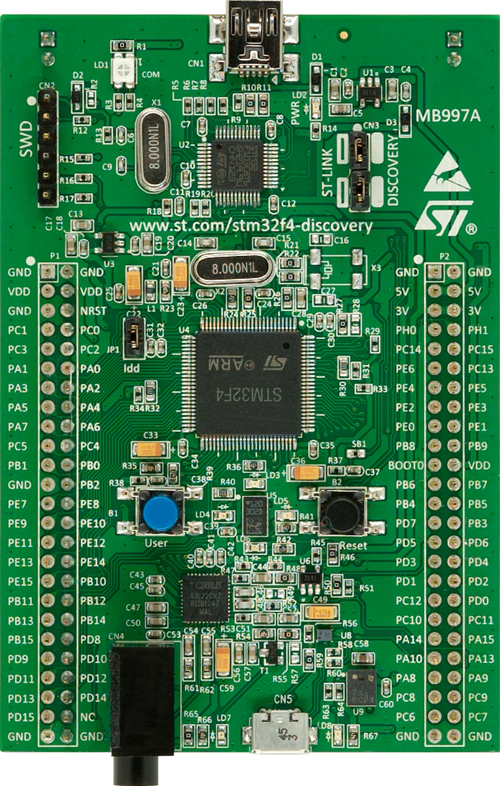
This very low cost board: ~12€ at  . Detailed information is available via ST web page. On-board is a STM32F407VGT6 microcontroller. On Board is an ST-LINK/V2 embedded debug tool, two ST MEMS, digital accelerometer and digital microphone, one audio DAC with integrated class D speaker driver, LEDs and push buttons and an USB OTG micro-AB connector. By removing two jumpers ST-LINK could be used to program external microcontroller.

Continue reading ‘STM32F4 Discovery and ULINK2’ »
18.10.2011, 23:01 by Mare

I have got STM discovery kit for STM32F4 devices. It’s populated with STM32F407 in LQFP 100 package.
Continue reading ‘STM32F4 schematic library’ »
22.06.2011, 17:36 by Mare
 AD7715:
The AD7715 is a complete analog front end for low frequency measurement applications. The part can accept low level input signals directly from a transducer and outputs a serial digital word. It employs a Σ-Δ conversion technique to realize up to 16 bits of no missing codes performance. The input signal is applied to a proprietary programmable gain front end based around an analog modulator. The modulator output is processed by an on-chip digital filter. The first notch of this digital filter can be programmed via the on-chip control register allowing adjustment of the filter cutoff and output update rate. The AD7715 features a differential analog input as well as a differential reference input. It operates from a single supply (3 V or 5 V). It can handle unipolar input signal ranges of 0 mV to 20 mV, 0 mV to 80 mV, 0 V to 1.25 V and 0 V to 2.5 V. It can also handle bipolar input signal ranges of ±20 mV, ±80 mV, ±1.25 V and ±2.5 V. These bipolar ranges are referenced to the negative input of the differential analog input. The AD7715 thus performs all signal conditioning and conversion for a single channel system. The AD7715 is ideal for use in smart, microcontroller, or DSP-based systems. It features a serial interface that can be configured for three-wire operation. Gain settings, signal polarity, and update rate selection can be configured in software using the input serial port. The part contains self-calibration and system calibration options to eliminate gain and offset errors on the part itself or in the system.
Protoboard is assembled with AD7715 and precision voltage reference REF5025. The AD7715 is ideal for bridge applications (like weigh scales, pressure transducers, thermometers, etc…) with ratiometric differential input and integrated PGA. PCB is single-sided.
Continue reading ‘16 bit ADC (AD7715) prototyping board’ »
21.06.2011, 01:54 by Mare
Ethernet PHY is required in every microcontroller application which uses ethernet interface. It consists of RJ45 connector, transformers and PHY controller, which is analog circuit – interface between transformers and ethernet controller in microcontroller.
Circuit is divided in two PCB to keep it simple and single-sided. It connects via 20 pads (2,54mm raster) in dual row. Ethernet cables are usually stiff. Dual-in-line style of this module provides better mechanical rigidity.

Universal ethernet PHY module
Continue reading ‘Universal ethernet PHY’ »
20.06.2011, 22:49 by Mare
This micro SD brekout board is usefull to connect micro-SD card to 2,54 mm header. Schematic is extremely simple:

Continue reading ‘Micro SD breakout board’ »
20.06.2011, 22:28 by Mare
 This LPC1700 prototyping board is modular and simple to build as single-sided PCB. I made it with toner-transfer method. No drilling is required, just SMD soldering. Complete board is modular. Normally, not all periphery is used all the time. Depending on project, there are just too many possibilities, which can not be covered by a single prototyping board. This schematic is just one example how to use miniature prototyping modules, which are described in other posts. Such modules have one big dvantage: they can be simply recycled and used in many prototypes. This protoboard is populated with USB and JTAG modules as absolute minimum for start debugging. USB module provides 3,3V power supply from USB port and JTAG interface is for debugging.
Other modules provided on this board are:
- ethernet PHY
- Micro SD socket
- Monochrome 128×64 graphical LCD
- 16 bit ADC
- 24 bit ADC
- audio amplifier
Continue reading ‘Modular LPC1700 prototyping board’ »
20.06.2011, 21:50 by Mare
Next simple board in “universal” series is JTAG adaptor. First was Universal USB adapter with power supply. Most commonly used JTAG connector is 20 pin IDC, found on many prototyping boards. It takes lot of board space and requires through hole drilling in PCB, which I usually avoid when building prototypes with single sided PCB, manufactured with toner transfer method.
This simple adapter has all neccessary pullups and pulldowns. Connector at one side is standard IDC20, at the other side are 9 pads in line with 2,54mm raster.
Files for JTAG adapter:
Soldered module:

Jtag interface module
 Two flex capton foils connects LCD side with periphery. Wider has dual row connector and narrower, 4 pin ribbon (probably the touch controller) has small connector. Remove orange adhesive tapes and pull the wider ribb on out from the board. Open the small connector (black part up!) and pull out the ribbon. Now warm up your soldering iron and unsolder the battery from the circuit (red B+ wire) to avoid “escaping smoke” effects. Isolate the red wire with some isolation! Continue reading ‘Archos tablet 10.1 repair’ »