Archive for the ‘MCU’ Category.
20.12.2014, 09:20
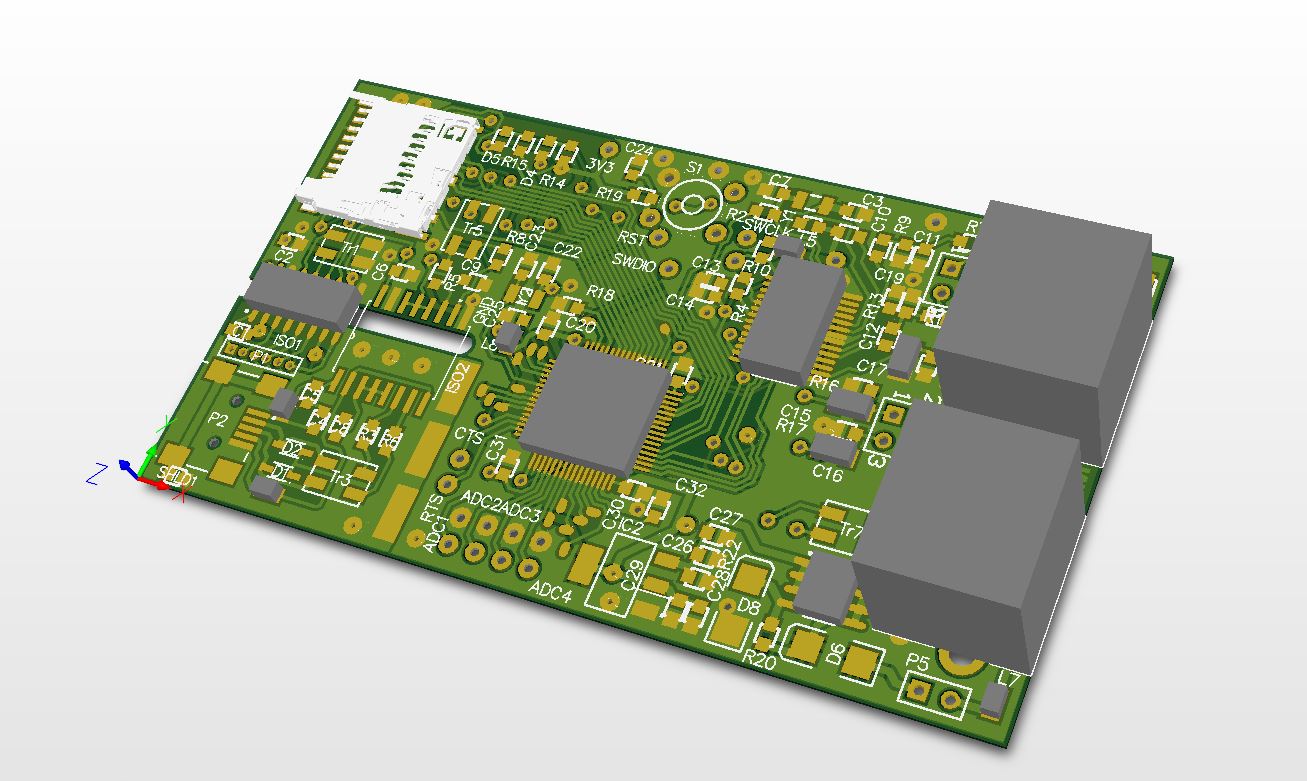
Full bunch of wires is hanging from each HAM station and PC connected to the station: CAT, audio, each via dedicated interface for isolation or level shifting. Additional mess is with parrots or digital interfaces for digital mode. I wanted simple solution, which can be conected to PC via single USB cable.
I was looking for simple audio CODEC and found WM8731. To have enough processing power for some simple DSP audio I chose cortex M4F microcontroller. There is also micro-SD on the board for audio recording and playback, two mini-DIN connectors with YAESU pinout and galvanic isolation for USB. I stareted this project few months ago. I will add posts when I will make progress with module programming.

The PCB is 80x45mm.
Here is schematic: modem
And PCB layout: lingva
Stay tuned for further progress reports.
The software will be published on git.
Category:
EFM32,
Ham,
MCU,
Micro-SD,
Periphery,
STM32F4,
Test equipment,
USB |
Comments Off on MODEM, parrot, CAT, …
11.07.2014, 21:23
This is next step in developing virtual COM port application. There arre two other parts required:
STM32F4 discovery – Keil example step-by-step
and first part of virtual com port tutorial:
STM32F4 discovery – Virtual COM port, step-by-step
In this example we will add DTR and RTS signals to two GPIO pins. Next, we will add simple command line interpreter for simple communication with the micorcontroller.
Continue reading ‘STM32F4 Discovery virtual com port – part II’ »
Category:
MCU,
STM32F4 |
Comments Off on STM32F4 Discovery virtual com port – part II
10.07.2014, 22:44
This is next step in developing applications with STM32F4 Discovery board and Keil tools. This step-by-step tutorial describes how to prepare the simple application which communicates with PC using virtual COM port. This application is based on LED blinky desribed in first tutorial. We will continue with same project. You can copy/paste the entire folder to new one or continue inside the existing “blinky”.
Continue reading ‘STM32F4 discovery – Virtual COM port, step-by-step’ »
10.07.2014, 20:49
Keil development tools are excellent and they surprise with new toys with every new release. With version 5 they started with “packs”. I was confused with this new concept and without any training it took me a while to adapt new approach. Now, after a while and after reading few manuals I can only say it’s fantastic. Preparing new application is a breeze. What I was missing is step-by-step tutorial for newcomers to the “packs”. I would like to present step-by-step tutorial for simple application.
We will start with STM32F4 Discovery board, a low cost nice development board with some interesting periphery. First example will be simple “blinky” with blinking blue LED.
Continue reading ‘STM32F4 discovery – Keil example step-by-step’ »
16.06.2014, 23:42
After successful installation of “bare” virtual com port it’s now time to add something useful to the communication. This example is based on tutorial projects :
If you followed first three parts, then it’s time to continue here. If not, I suggest you do to gain proper background and learn about creating virtual COM port application.
Continue reading ‘STM32F4 Discovery virtual com port – part III – COmmand line interpreter’ »
Category:
MCU,
STM32F4 |
Comments Off on STM32F4 Discovery virtual com port – part III – COmmand line interpreter
01.03.2013, 23:57
Energy micro has wonderful demo/proto boards. But sometimes it is more useful to have bare module without any periphery. Jut fan-out-ed pins, power supply and oscillator. Pins should be 100mils raster in order to stick the module inside other protoboards.
Presented protoboard is the one, which fits in above requirements.

Assembled EFM32G880 board
Continue reading ‘Prototyping board for energy micro EFM32G880’ »
24.10.2011, 22:22
Last time I was connecting STM32L discovery to the ULINK2. Now it’s time to connect new “beast”.
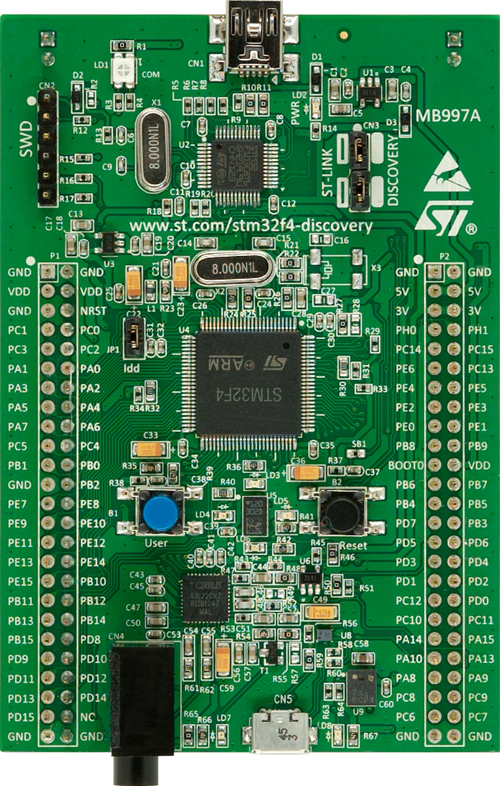
This very low cost board: ~12€ at  . Detailed information is available via ST web page. On-board is a STM32F407VGT6 microcontroller. On Board is an ST-LINK/V2 embedded debug tool, two ST MEMS, digital accelerometer and digital microphone, one audio DAC with integrated class D speaker driver, LEDs and push buttons and an USB OTG micro-AB connector. By removing two jumpers ST-LINK could be used to program external microcontroller.

Continue reading ‘STM32F4 Discovery and ULINK2’ »
18.10.2011, 23:01

I have got STM discovery kit for STM32F4 devices. It’s populated with STM32F407 in LQFP 100 package.
Continue reading ‘STM32F4 schematic library’ »
20.06.2011, 22:28
 This LPC1700 prototyping board is modular and simple to build as single-sided PCB. I made it with toner-transfer method. No drilling is required, just SMD soldering. Complete board is modular. Normally, not all periphery is used all the time. Depending on project, there are just too many possibilities, which can not be covered by a single prototyping board. This schematic is just one example how to use miniature prototyping modules, which are described in other posts. Such modules have one big dvantage: they can be simply recycled and used in many prototypes. This protoboard is populated with USB and JTAG modules as absolute minimum for start debugging. USB module provides 3,3V power supply from USB port and JTAG interface is for debugging.
Other modules provided on this board are:
- ethernet PHY
- Micro SD socket
- Monochrome 128×64 graphical LCD
- 16 bit ADC
- 24 bit ADC
- audio amplifier
Continue reading ‘Modular LPC1700 prototyping board’ »
20.06.2011, 21:50
Next simple board in “universal” series is JTAG adaptor. First was Universal USB adapter with power supply. Most commonly used JTAG connector is 20 pin IDC, found on many prototyping boards. It takes lot of board space and requires through hole drilling in PCB, which I usually avoid when building prototypes with single sided PCB, manufactured with toner transfer method.
This simple adapter has all neccessary pullups and pulldowns. Connector at one side is standard IDC20, at the other side are 9 pads in line with 2,54mm raster.
Files for JTAG adapter:
Soldered module:

Jtag interface module