04.06.2016, 22:04 by Mare
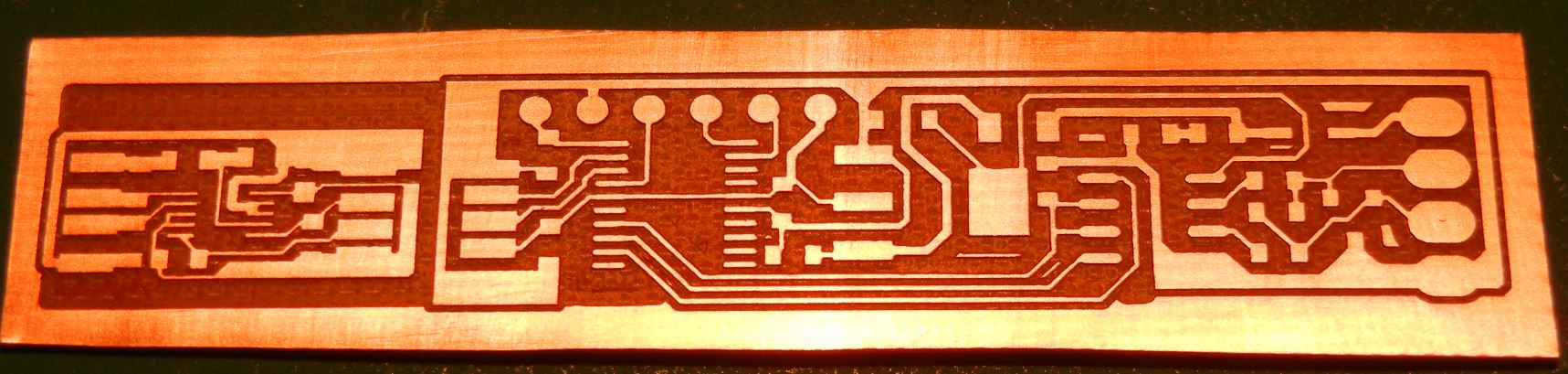
Communication between microcontrollers is always interesting topic. I was looking for simple, efficient and reliable protocol between several microcontrollers. First I have to choose the physical layer. One of the most commonly used multipoint buses is RS485. Due to simplicity I choose half-duplex RS485. Only two wires is all it needs to establish link between two devices:

Continue reading ‘HDLC-Like data link via RS485’ »
02.06.2016, 14:37 by Gal

Finished pad
What happens one a man has too much time and a workshop with fancy toys in his garage? With school being too easy and girlfriend nowhere to be found I often find myself exploring areas that interest me. It started with drones, electric powered bikes and longboards but for the last month I often found myself dancing. Firstly, I borrowed my friend’s softmat which was okay for the beginning but soon I progressed with my dancing skills and started to hate everything about it. I’m sure all DDR dancers know what I’m talking about. That’s when I decided to build one.
Continue reading ‘Metal dance pad with load cell sensors’ »
Category:
Mechanics |
Comments Off on Metal dance pad with load cell sensors
29.05.2016, 22:19 by Mare
Testing of sensors with RS485 using PC without proper interface is not possible. Since RS232 interfaces are very rare, the interface should be hooked to USB. The interface between USB and RS485 can be soldered with one of the many FTDI interfaces with added RS485 driver, or bought as assembled module. There is always the third option. I made it from scratch.
I took smallest STM32F0 with USB and UART interface. The best thing with UART in the STM32F0 is that signal for driver enable is provided within hardware. The complete pinout of the microcontroller is:

Continue reading ‘USB to RS485’ »
20.05.2016, 20:58 by Mare
FRDM-K64F is nice piece of development board. Unfortunately, it is “bonded” to MBED development platform, which is a nightmare! Adding RS485 “out of the box” to the FRDM-K64F in MBED is NoGo. But it is very easy.
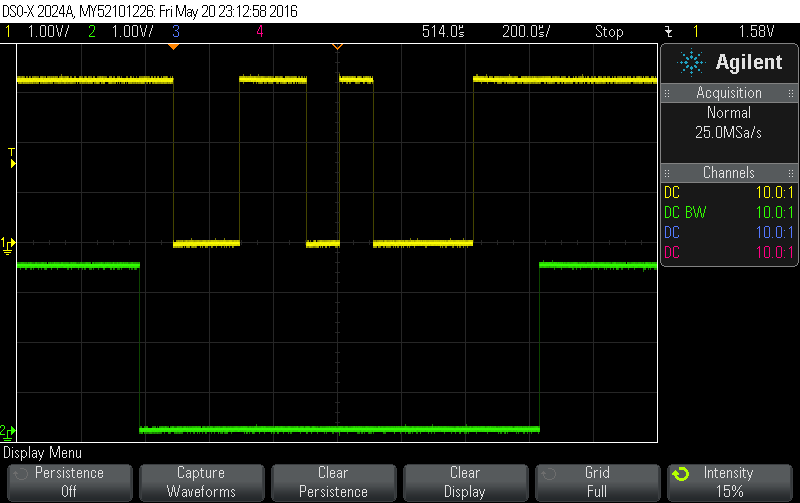
Here is image from my scope sending single char via UART4 with enabled RTS as DE for RS485 in Half Duplex mode:

Continue reading ‘Adding RS485 to FRDM-K64F’ »
18.05.2016, 21:37 by Mare
I got samples of Si7013.
The Si7013 I2C Humidity and 2-Zone Temperature Sensor is a monolithic CMOS IC integrating humidity and temperature sensor elements, an analog-to-digital
converter, signal processing, calibration data, and an I2C Interface. The patented use of industry-standard, low-K polymeric dielectrics for sensing humidity enables the construction of low-power, monolithic CMOS Sensor ICs with low drift and hysteresis, and excellent long term stability. The humidity and temperature sensors are factory-calibrated and the calibration data is stored in the on-chip non-volatile memory. This ensures that the sensors are fully interchangeable, with no recalibration or software changes required. An auxiliary sensor input with power management can be tied directly to an external thermistor network or other voltage-output sensor. On-board logic performs calibration/linearization of the external input using user-programmable coefficients. The least-significant bit of the Si7013’s I2C address is programmable, allowing two devices to share the same bus. The Si7013 is available in a 3×3 mm DFN package and is reflow solderable. The
optional factory-installed cover offers a low profile, convenient means of protecting the sensor during assembly (e.g., reflow soldering) and throughout the life of the product, excluding liquids (hydrophobic/oleophobic) and particulates. The Si7013 offers an accurate, low-power, factory-calibrated digital solution ideal for measuring humidity, dew-point, and temperature, in applications ranging from HVAC/R and asset tracking to industrial and consumer platforms.
I prepared prototyping board with STM32F0 and line RS485 driver:


Continue reading ‘SiLabs Si7013 humidity and temperature sensor’ »
09.05.2016, 22:33 by Mare
Kinetis K64F demo board is excellent little board for experimenting with ethernet. There is no quick step-by-step tutorial for building simple web server on this board. The following instructions help bringing working HTTP server on FRDM K64F with one index page and second page with simple CGI script to print out some random numbers. This is absolute minimum for developing any web based gadget with this board.

(image source: https://mcuoneclipse.com/2014/04/09/ftf-frdm-k64f-kinetis-design-studio-and-kinetis-sdk/ )
What you will need:
- Compiling tool: Keil development tools
- Hardware:
- Good to read: HTTP server demo application
- LAN cable and spare port on your switch or router
Continue reading ‘Simple WEB server hosted on NXP/Freescale FRDM K64F demo board’ »
04.05.2016, 20:56 by Mare
Affordable precision pluviometer PART 1 (introduction and construction) is here.
Here are first analog measurements of the affordable precision pluviometer:
| mL |
uV |
uV/mL |
| 0 |
550 |
|
| 10 |
568 |
|
| 30 |
606 |
1.87 |
| 50 |
643 |
1.86 |
| 100 |
736 |
1.86 |
| 200 |
924 |
1.87 |
| 300 |
1109 |
1.86 |
| 400 |
1296 |
1.87 |
| 500 |
1483 |
1.87 |
| 600 |
1672 |
1.87 |
| 650 |
1762 |
1.86 |
| 700 |
1853 |
1.86 |
| 750 |
1949 |
1.87 |
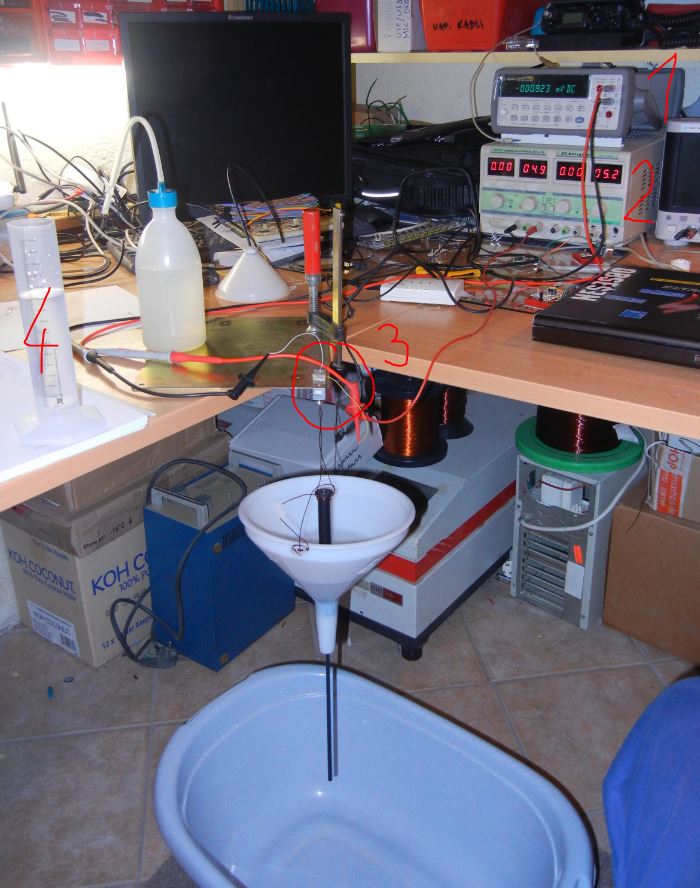
The measurement setup was: measuring graduated cylinder (4) strain gauge sensor (3) from kitchen scale, power suuply (2) and digital multimeter (1):

Continue reading ‘Affordable pluviometer part 2 – strain gauge measurements’ »
20.04.2016, 18:38 by Mare
Somewhere in year 1995 I had idea for anemometer without movable parts. I forgot about that and recently I started building weather station for the vine yard. Now it’s time to transfer that idea to reality.This is the sketch from that time:

I am working in company HYB in R&D department. My experience with pressure sensors is longer than the anemometer idea (more than 20 years). Our main products are sensors. We have industrial pressure sensors for extremely low pressures. Lowest full scale pressure sensor goes as low as 1mbar (one millibar!). Just for impression: this is equal to 1cm of water column – one cm under the water surface is 1mbar pressure. The model, most suitable for annemometer based on wind pressure measurement is HPSD 3000:

The sensor has 15 bits I2C output for pressure and temperature via I2C interface. The sensor is available through our distributor or ask directly here.
Continue reading ‘Anemometer without moving parts’ »
Category:
Ham,
WX |
Comments Off on Anemometer without moving parts
20.04.2016, 17:57 by Mare
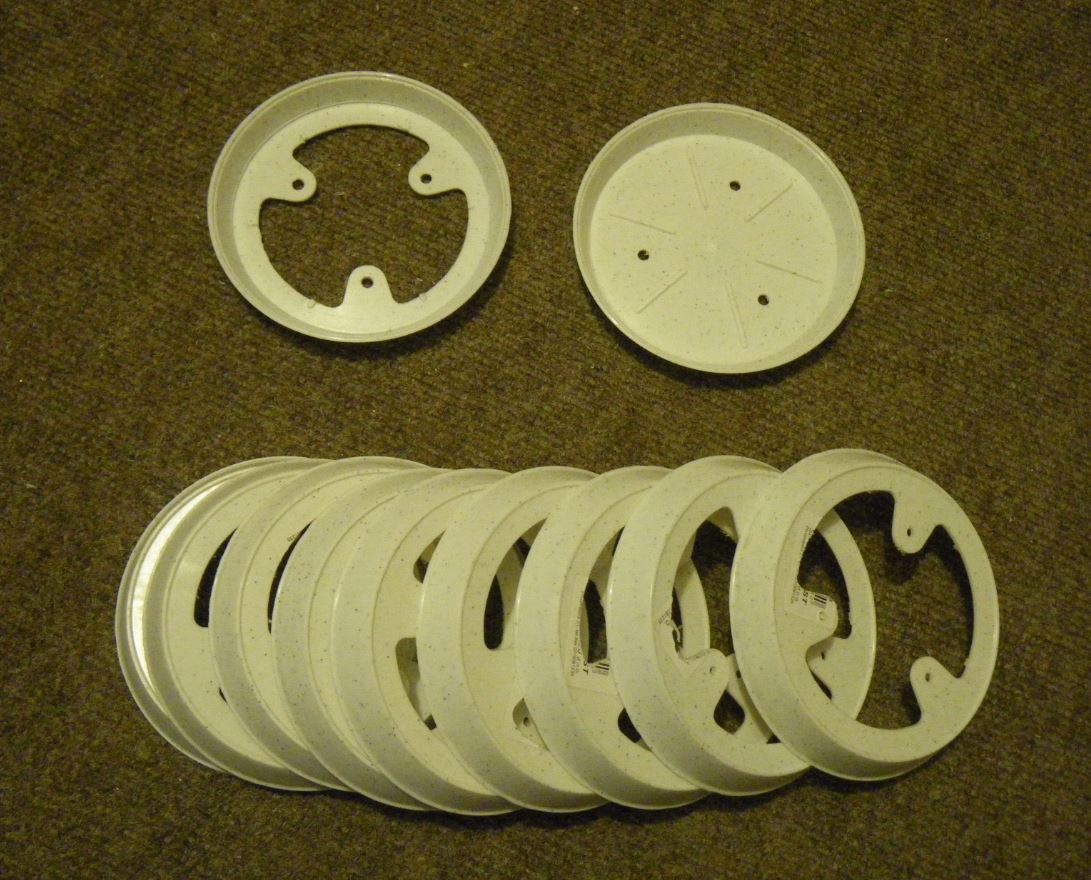
The white plastic radiation shields that protect the temperature, humidity and other sensitive sensors from any direct sunlight can be built for bargain. I started with trays from local garden shop. They sell for about 10 cents per tray with diameter 120mm (5 inches). About 10 trays were CNC machined:

Continue reading ‘Low cost sun shield for weather sensors’ »
Category:
Ham,
WX |
Comments Off on Low cost sun shield for weather sensors
20.04.2016, 11:27 by Mare
12V high current linear power supply is very useful for HAM applications. I designed one based on s53mv schematic. The circuit is somehow odd because regulation transistors are in negative side of the current loop. Main reason for that is the collector or source of the transistors, which is connected to the housing of the transistor. To avoid isolation of the transistors from the heat sink it is better to have the housing, heatsink and the transistors connected to negative rail of the power supply. It is similar to the car, where negative pole is connected to the chassis.


Continue reading ‘12V Power supply’ »